Sunday, December 22, 2013

Advent


There is big excitement in Norway when Advent season starts.  I spent my whole life not knowing what “Advent” meant, so the tradition was a new one for me. 

Advent is huge in Norway as it begins the arrival of the Christmas season.  Special candles get lit on each of the four Sundays before Christmas to “light the way” in anticipation of Jesus’ birth.  It’s all very symbolic and special. I’m glad we got to go through it in Norway where the whole country celebrates this tradition, even if they aren’t professing Christians.

Norway used to be known as a “Christian” nation but they recently changed that to “secular and Christian,” as there are nearly as many professing “humanists” as “Christians.”  Many believe in the Bible and that Jesus is God’s son and He died on the cross and rose again, but they brush it off with, “We just don’t take it personally.”  

Advent is not so much about religion any more, as it is tradition.  There’s not a house in the land that doesn’t have some kind of light in their window for Advent – either a lit star, or an electric set of candles that sit on an upside down V in the windowsill.  Many houses have lights shining in every window and none of them get turned on before the first day of Advent, which is this coming Sunday.

There is a great deal of conformity in Norway as no one would dare turn on their lights early because, “You just don’t do that.”  That’s a phrase I often heard about many things.  There’s a lot of pride in everyone doing things properly, and no one “over does it” with Christmas lights like some American’s do.  They laugh a great deal at our excessive and garish ways.  Most people use only white lights, too.  I guess colored ones are a bit too gaudy by Norwegian standards.

The calendar fills up during Advent, as it’s by far the busiest season of the year.  The State Church and schools send out flyers with all the different events going on in December.  My son’s school held a special kick-off party the first day of Advent with the lighting of the school’s Christmas tree at five o’clock on a Sunday.  The school band played a few Christmas songs, the drill team performed a little march to one of the tunes, and after a quick speech, the lights came on the tree and everyone cheered.  They handed out gingersnap cookies, tangerines and hot Glogg  - a very tasty Scandinavian Christmas drink.  All of this took place outside on the school playground in below freezing temperatures. 

The hardiness of Norwegians is very impressive, especially when they brave the elements of nature.  I’m sure, had it been raining hard or even snowing, the show would have still gone on to a packed house. 

It’s funny, they seem to have put God in a box, but they sure don’t want to be there themselves.

Thanksgiving


Pulling off the traditional Thanksgiving meal the year we lived in Norway was a bigger challenge than I anticipated. I couldn’t get all the ingredients I needed and I felt it nearly miraculous I even found a whole turkey.  A nine pounder was as big as I could buy, about half the size I’m used to cooking.

Knowing the holiday was before us, I asked some American friends that came for a visit months earlier, if they wouldn’t mind bringing me items I quickly discovered weren’t available in Norway. I wouldn’t have been able to make a pumpkin pie if they hadn’t brought canned pumpkin, vanilla and brown sugar. A Norwegian cousin also made a quick trip to Kansas for his job, so he brought me back pecans for pecan pie, otherwise that wouldn’t have been on the menu, either.

Trying to find spices like nutmeg and cloves proved expensive and very frustrating.  All the foil packages of spices had the exact same illustration on the outside and their Norwegian names were a total mystery.  I bought several packages then opened them up like Christmas presents to see what was inside. I ended up with several unusable powders I didn’t recognize. Unfortunately, I never found everything I needed, but I seemed to be the only one that noticed flavors were missing from the recipes.

My favorite cornbread recipe has a can of creamed corn in it. I was so bummed that I couldn’t make it because not only is creamed corn not available, but I couldn’t even find any cornmeal. I thought I hit the jackpot one day when I bought a box of something with a picture of corn on the front, but soon discovered it was cornstarch.

We still had much to be thankful for though, and we were glad to share our American holiday with our Norwegian relatives.

As is our tradition, we went around the table and everyone said two things they were thankful for but it took some of them a while to come up with something, as giving thanks isn’t really a Norwegian thing. It was fun to watch their expressions as they tasted foods they’ve never seen, like stuffing and yams with marshmallows. Surprisingly, the pumpkin pie didn’t go over too well - they all said it must be an acquired taste - but we were glad for that - all the more for us.

Except for eating turkey and pumpkin pie, it didn’t feel much like our traditional Thanksgiving back home because both Kaleb and I had to go to school that day and the day after.

The night before, when I baked the pies, I stuck the knife in to see if they were done. I let Kaleb lick the knife, and with a dreamy lilt in his voice, he said, “Ahhhh, it tastes like home.” And I guess that is what was missing on that Thanksgiving Day. Thanksgiving is an all American holiday that plays out best at home.

The Rest Party


Relaxing is a huge priority in Norwegian’s lives.  It seems to me they live just to relax.  They have a couple different terms they use to describe this special time in their lives – one is “slapp av” which translated means “relax” and another is “kose deg” which means “enjoy yourself” - in a cuddly kind of way.

Each day, it’s important that Norwegians both relax and enjoy themselves.  Those two things actually go hand-in-hand.  I’m honestly surprised they get anything done, as there is so much emphasis put on just taking life easy.  In the work place, the law states that all employees have a right to be “stress free.”  If an employee feels stressed, it’s justification for taking an extended sick leave where they get paid to have time to just “slapp av.”  I read a newspaper article a few years ago that said on any given day, over twenty five percent of employed Norwegians are not at work. 

Even in their schools, the emphasis is not on academics – they care more that the children enjoy themselves while they are there, than actually learn anything meaningful.

If the sun is shining, Norwegians enjoy themselves out on the deck.  A cup of coffee in hand is also an important part of the “kose deg” experience. 

My husband’s cousin met up with us in Florida once because he wanted to go to Disneyworld.  Our schedules were such that we only had two hours together that day, but he still insisted we go.  Once we got through the entrance gates, all he wanted to do was sit down and have a cup of coffee.  That was how he planned to enjoy Disneyworld.  I thought he was nuts, but from what I can tell, many Norwegians are cut from the same mold.  Nothing could be better than just sitting down and enjoying the moment, with a cup of coffee in hand, no matter where they are in the world or how much it cost them to get there.

So when we were living in Norway, I got a text message from my friend Kristin, inviting me to a “reste selskap” – which I thought translated as a “rest party.”  I’d never heard of such a thing before and had no idea what it meant.  The first thing I thought was that Kristin was going to have a bunch of people over to just relax together.  It made sense.  Then I thought maybe it was something like a Tupperware Party, where we buy things to help us “rest.”  Both ideas seemed possible based on my experience with Norwegians.  Either way, I thought I should go.

I was pleasantly surprised when I showed up at Kristin’s house to see her table covered with fourteen partially eaten cakes.  As I soon found out, Kristin’s daughter was Confirmed the day before, so I and several other friends, were invited over to eat the “rest” of the food from that party, which I enjoyed very much.

Clicks


I had several major “clicks” pertaining to my husband, the year we lived in Norway.  I was not previously aware that many of my irritations with him were just his cultural norm.  Now I know.  

The first click came the day I learned about pronouns in my Norwegian class.  There are different pronouns to say “hers” or “his” of course, but Norwegians use extra pronouns for those same words, depending on whether the “hers” or “his” is the object or subject in a sentence.   

To say “her” as the object, it’s “hennes,” but as the subject, it’s “si.”  Often, when Kory is retelling a story, and there are more than two people of the same gender involved, he completely loses me and I have no idea who did what.  Now I know why - the English language is limited in their use of pronouns.  The Norwegian language makes it much easier to track who the “he” or “she” is in the conversation and since that is my husband’s native tongue, his brain thinks of those language rules first.  When Kory talks in English, he converts everything to just “he” or “she” and while it’s perfectly clear in his mind, I’m always having to ask him, “Who are you talking about?” because he never clarifies by using their names. It’s just so darn irritating.

Another “click” came in the arena of Kory’s palate. When we were first married, I made him some yummy lemon chicken and when I asked how he liked it, all he could say was, “I like my chicken to taste like chicken.”  Apparently the effort I put into marinating the chicken in lemon juice for 24 hours was not appreciated.  After having been around Norwegian food for a year, I now realize they boil or steam nearly everything and put spice on practically nothing. 

But the biggest “click” about Kory came the day The Good Teacher Inga told us that Norwegians don’t really tell anyone they love them.  Maybe once, before getting married, they might utter the word “elske” (love), but for the most part, it’s a very rarely used word.  Even parents talking to their children don’t say it.   

They have a saying, “Jeg er glad i deg,” which literally translates as “I am happy with you.”  That’s it.  That’s all you get.  That’s their toned-down version of “I love you.”  That’s what spouses say to one another and that’s what parents tell their children.  There is no love being spread around in Norway, that’s for sure, unless they are talking about Norwegian chocolate, then someone might be brave enough to utter the “elske” word. 

Years ago when I complained about his lack of verbal affection toward me, Kory just gave me the old line, “I told you I loved you when we got married.  If I change my mind, I’ll let you know.”  It’s been 22 years.  If he ever does tell me he loves me again, I sure hope he doesn’t use any pronouns.  

Flags


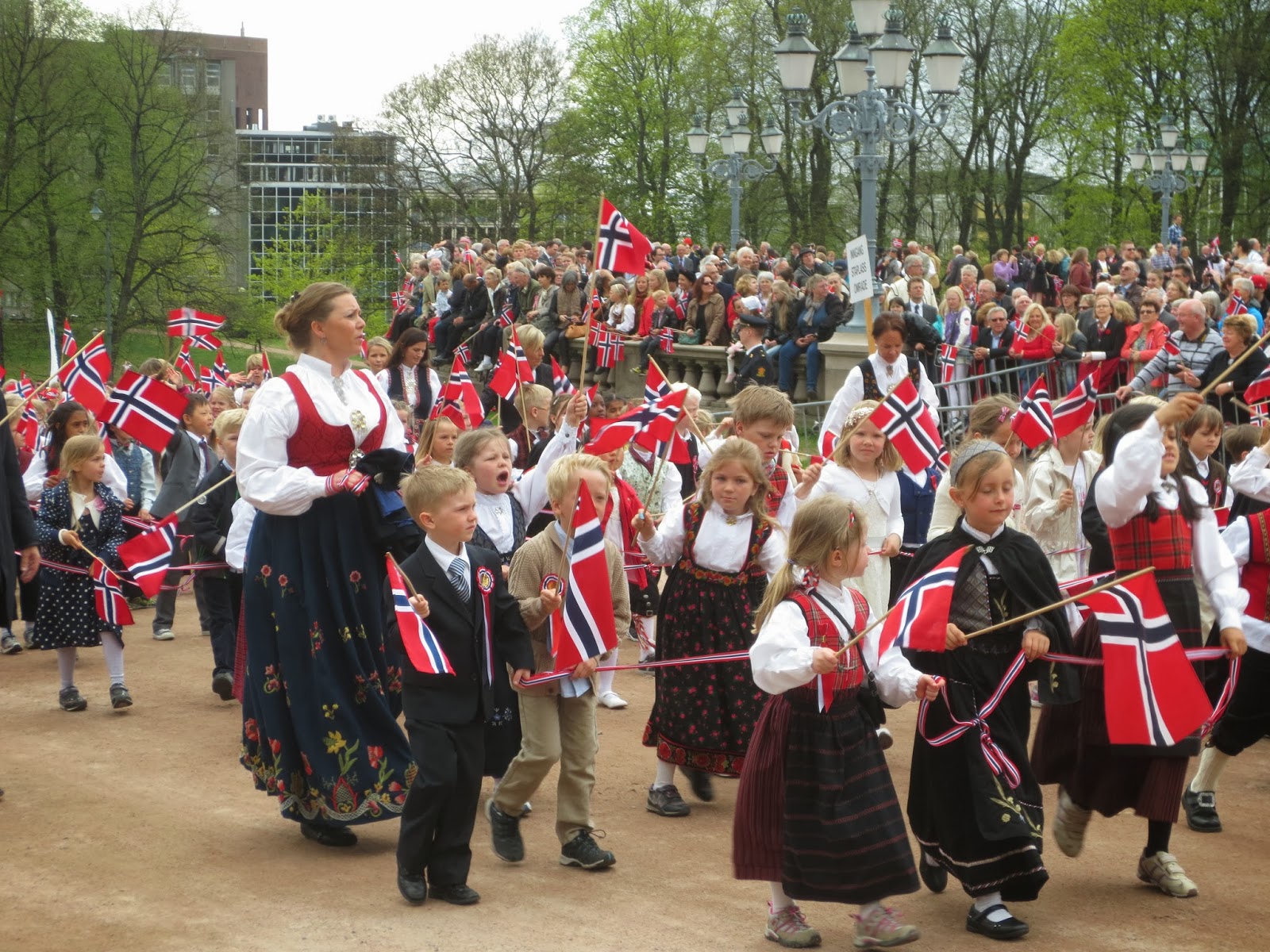
I think Norwegians love their flag, even more than they love their own mothers.  I’ve never experienced anything like it.  They beam with pride when they gaze upon it, as if watching their child take its first step.  It might have something to do with that first step Norway took away from their tie with Sweden back in 1814, or that the Germans wouldn’t allow it’s presence to be seen at all during WWII.

Unlike the flag in America, that can fly anytime, the display of the Norwegian flag is highly regulated.  I’ve noticed, just by being a parent, when something is restricted, it creates a greater desire for that thing – so that might have something to do with their passion for it.

Every flag purchased has a card attached with all the rules surrounding its use.  America has certain rules around the use of its flag, too, but I’m guessing only the Boy Scouts know them by heart, but in Norway, everyone knows them.  

To begin with, the flag is only allowed to fly on national holidays like New Year’s Day, Easter, 17th of May, Labor Day, Pentecost and Christmas.  It’s also allowed on the birthdays of royal family members.  When the flag is flying outside individual homes on days other than these, it signifies some big celebration is going on, whether it’s a birthday, wedding, baptism or confirmation.  I’ve even seen the flag flying to signify visitors have come from America.  The flag is also allowed to fly at half-mast if someone has died.  The State Church flies their flag at half-mast also, but only during the time of the funeral.

The time of day the flag is allowed to fly is also very regulated.  During the winter months, November through February, it can’t be hung out until nine in the morning and must be back in by nine at night.  The rest of the year it can come out at eight o’clock. The rules slightly change for those folks that live way up north – they are only allowed to fly their flag from ten in the morning until three in the afternoon because they have so much less daylight.  I’m sure some have moved further south just so they can fly their flag longer.

As predictable as the church bells are on a Sunday morning, on days the flag is allowed to fly, at the exact moment the hands of the clock strike the hour, front doors open, and flags appear.  Everyone is standing just inside their door like a runner at the starting gate, waiting to be the first one on their street to fly it.  Likewise, I’ve been to parties where people leave early in order to bring in their flag by “quitting time,” or they arrange with a neighbor to take it down.

Inside every home is a tabletop version of the flag, displayed year round, 24 hours a day.  Thankfully, there are no regulations around that one so the Norwegians have reason to smile each and every day.