Sunday, August 28, 2011

Impressions


We just finished hosting a family of five from Norway for three weeks.  The youngest boy is a friend of my son, Kaleb, so we invited the whole family over for their first ever visit to America.  It was interesting to hear their observations of differences between our two countries.

Janne, the mom, said, “Everyone here greets each other with open arms and a big hug.”  That would never happen in Norway, where a polite handshake and a smile is the norm.  Janne practiced the American style of hugging on a few of my friends and it made her laugh every time.  It’s out of her comfort zone to give a hug.  She noticed how often Kaleb hugged me or sat on my lap and she commented several times she thought it might become a problem for Kaleb as he ages, that we are “so close.” 

Haavard, the dad, spent time talking politics with my husband, so he noted that Americans have more political choices than Norwegians do.  In Norway, no one but the politicians are allowed to vote on particular matters.  Norwegians can only vote in their politicians, but then have no voice on any issues.  They can call an election at any time, however, and vote out whoever they want.  Sweet.

Sondre, the 18-year old, said he liked how cheap the prices are in America.  Nearly every day he was here, he asked if we could stop by Wal-Mart.  He also liked Ross, where their family bought 21 pairs of shoes to take home.  A pair of name brand tennis shoes costs about $250 in Norway, but at Ross, they got them for about thirty bucks.

Haakon, the 15-year-old, noticed right away that the roads are so much bigger, with so many more lanes on each side.  We were stuck in traffic a few times, however, so he could see, they still weren’t big enough.

Andre, the 11-year-old, liked all the food.  He thought the candy and snack options were better, as well as the fast food choices.  Eating out in Norway is ridiculously expensive so Andre came to love Taco Bell, Subway and Costco pizza while he was here.

The whole family noticed we are on different time schedules.  Norwegians tend to stay up until the wee hours of the morning, then sleep til noon when they are on vacation.  One day they wanted to go to the beach but they weren’t ready to go until four.  They’re used to the sun never setting in the summer, so their days never end in Norway, but here, the days often ended shortly after we arrived at our destination. 


Saturday, August 20, 2011

Hardy Folks


Just a few weeks ago we were invited to an outdoor “family fun day” sponsored by our church.  It happened to be pouring down rain that Saturday, but we put on our rain jackets and headed out anyway.  I guess we’ve been around Norwegians enough that we realize “rain happens” but it doesn’t have to ruin any plans.  We were shocked when we showed up and no one else was there. 

When we lived in Norway, families put on their raincoats, rain pants and boots and headed on out, hiking in the mountains, walking in the neighborhood, riding bikes into town – all in the rain.  It rains so much in our hometown in Norway that if people waited for a nice day to do anything outdoors, they’d never get outside.  My son even complained when he attended school there that they must go outside during recess, no matter what the weather.

When we lived in Norway we were invited to a school beach party.  It was pouring down rain that day but everyone still showed up with their little beach grills and hot dogs.  People stood around under umbrellas, grilling and carrying on conversations like nothing was wrong with the day.  Kids played soccer in the rain while parents prepared the picnic. 

Norwegians are a hardy bunch.  Even in the winter, the kids play soccer in the snow.  One of the funniest things we saw was a snowplow working the local soccer field.  They cleared the field and piled up the snow around the edges so the kids could still have their practice.  In America, my son was on a soccer team for a few years in LaConner.  They played for eight weeks in the fall.  I signed him up for soccer in Norway and was shocked to find out they play soccer all year around, except for eight weeks in the summer.  He didn’t make it the whole year, it was just too brutal.

Summer weather in Norway is often brutal as well.  My husband’s cousin Odd (pronounced “Ode”) likes to say, “If it’s summer, we’re outside.”  He has a deck with an outdoor heating unit attached and plenty of wool socks and blankets in which to bundle up.  No matter what the weather, if it’s summer, he is indeed, outside enjoying the fresh air, eating dinner, having a beer, reading the newspaper.  It all must be done outside.

Helly Hansen, a famous Norwegian outdoor sportswear company has encapsulated the entire Norwegian philosophy by creating a slogan that gets repeated often in Norway on rainy days -  “There’s no such thing as bad weather – just bad clothes.”  How true it is.


Saturday, August 13, 2011

Thanks


There are many ways to express thanks when in Norway.  The most common expression is “Tusen takk” - it means “A thousand thanks.”  My husband, Kory, jokingly explains to people that for years, Norway could never afford to say, “Thanks a million,” because they were a poor country.  Times have changed that, but the “Tusen takk” remains. 

When paying for something in the store, the person giving back the change often says, “Thanks shall you have,” (“Takk skal du ha”) as a way of saying thanks for shopping there.  It sounds awkward to me.

When greeting someone you haven’t seen for a while, whether it’s been just a day, or years, it’s customary to say, “Thanks for last” (“Takk for sist”), which is shorthand for, “Thanks for the last time I saw you.  I still remember it fondly.”  I like that greeting.

After eating, one should always say, “Thanks for the food,” (“Takk for maten”).  Often children will jokingly say this little rhyme to their parents, “Takk for mat og takk for drikke, oppvasken tar jeg ikke,” which means, “Thanks for the food and drink, but I won’t clean up.”

In very traditional homes, the children will walk over to their mother, curtsy or bow, shake her hand, and say their thanks for the meal.  That routine was common a few generations back and still survives in some homes today.  Of course now, the thanks would go to whoever made the food, mother or father.

It’s common to thank God before eating and in many Christian homes, a prayer of thanks is also said when they are done.  My favorite pre-meal prayer translates as, “Many have food but cannot eat.  Others can eat, but have no food. We have food AND we can eat, therefore we will praise the Lord.”  My son’s favorite is, “Food, Hallelujah, Amen.”

When departing someone’s home, it’s important to say, “Thanks for me” (“Takk for meg.”)  It’s shorthand for, “Thanks for inviting me, I had a great time.”  If spending the night in a Norwegian’s home, before retiring, it’s polite to say, “Thanks for today,” (“Takk for idag.”)

I’ve made plenty of mistakes speaking Norwegian, even when just saying “Thanks.”  We were invited over for an evening at some friend’s house.  As we said our goodbyes, I said what I would normally say in English at the end of such a lovely night -“Thanks for everything.”  But when I translated that to Norwegian and said “Takk for alt,” I got a startled look from our hostess and she jokingly asked if I thought she was going to be dying soon.  I quickly learned that in Norway, “Thanks for everything” is only said to a dead person.  Oops. 

Friday, August 5, 2011

Kissin' Cousins


My dad grew up in the Ozark Mountains of southern Missouri and he used to tell me some pretty funny jokes about family members marrying each other.  They were just jokes, though, and based on my genealogy research for his side of the family, no one was even remotely related to one another.  We still had some good laughs about the stereotypes of those “hillbillies” down south, where everyone was related.

That whole intermarriage thing isn’t really a joke when it’s true to life, though. No where have I seen family trees looking more like vines than in researching Norwegian family roots - including my mother’s side of our family.  I’ve also helped many friends do research on their Norwegian ancestry and I’ve yet to find a tree that didn’t have some family members marrying each other.  They obviously didn’t get out much.  First and second cousins marrying each other was very common in the old days, but shockingly, it still happens today.  It’s not illegal in Norway for first cousins to marry.  In fact, the parents of the King of Norway himself are first cousins.

The year we lived in Norway we met one of our neighbors – a young guy from California whose mom grew up just down the street from where we lived.  He was living in Norway for a few years just for the fun of it.  As we got to talking we discovered he is related to my husband, Kory, which caused the conversation to turn to how it seems everyone is related to everyone else in that area.  He told us when he meets a woman he’s interested in and asks her on a date, before he ever kisses her, he finds out where her family came from, for that very reason.  Unbeknownst to him, he’d been on a few dates with second cousins and it grossed him out.  He had no desire to become Kissin’ Cousins with anyone.  Coming from America, he has a different view on things than the Norwegians, who think it’s perfectly normal.

Jens, one of Kory’s relatives, married his own second cousin.  Jens didn’t know at the time he started dating her that they were related, but once he found out they had more in common than he initially thought, it didn’t stop their affections.  Jens’ parents were first cousins - so being married to his second cousin didn’t seem so bad to him.  Two of Jens’ great grandparents were siblings and their other sibling was the great grandfather to his wife.  That family tree is a very twisted vine, but all the descendants seems just fine to me – not at all like some of the people we’ve seen running around in the Ozarks.


Wednesday, July 27, 2011

Drunk Drivers


Random traffic stops by the police in Norway are common.  They set up road blocks and check every car that passes by for things like bald tires and other safety issues, unbelted passengers, people talking on cell phones and drunk drivers.  Norwegian officials don’t mess around when it comes to driving drunk.  They have zero tolerance for it and the consequences are so severe, very few people ever do it.

Norway has the strictest laws in Europe on drunk driving.  The legal limit is 0.1%, which isn’t much.  A spoonful of cough syrup might push one into the illegal zone.

Whenever we have been to a dinner party, or hosted one, there is always a designated driver and that person won’t even touch their lips to alcohol the entire evening.  When we’ve been out to a restaurant and everyone’s had a drink or two, we either take a taxi home or have someone come get us. Some people will walk an hour home even if they’ve had just one drink, because no one ever wants to run the risk of getting caught.  There is mandatory jail time involved plus loss of driver’s license and a huge fine which is on a sliding scale and usually the equivalent to a month and a half’s salary times how many points over 0.1% a person is.

There is no plea bargaining or getting a good lawyer to help out in drunk driving cases, so if a person gets caught, they are guilty.  The consequences are swift and steep.  (America has a thing or two to learn about handling drunk drivers in that regard.)

One guy I read about, the son of a rich ship builder, got caught in a random road side stop with a 0.9% alcohol level.  He had to pay about $130,000 for his drunk driving ticket, spend three weeks in jail and he lost his license for over two years.  When stuff like this makes the headlines, people understand that zero tolerance means zero tolerance no matter who you are.  The law states if he gets caught driving drunk again within five years, he’ll lose his license for life.  They don’t mess around.

I also read about a woman that got caught in a random stop with alcohol on her breath.  She spent thirty days in prison chopping wood, she lost her license for three years, had to go to rehab, and her fine was the equivalent of about $78,000.  Her blood alcohol level was 0.7%, which in Washington State, isn’t even illegal.

Sunday, July 24, 2011

Prayers and Peace for Norway, please.

I'm sad beyond words.  It's like an innocent child being molested.  Norway may never be the same.

Wednesday, July 20, 2011

Weddings


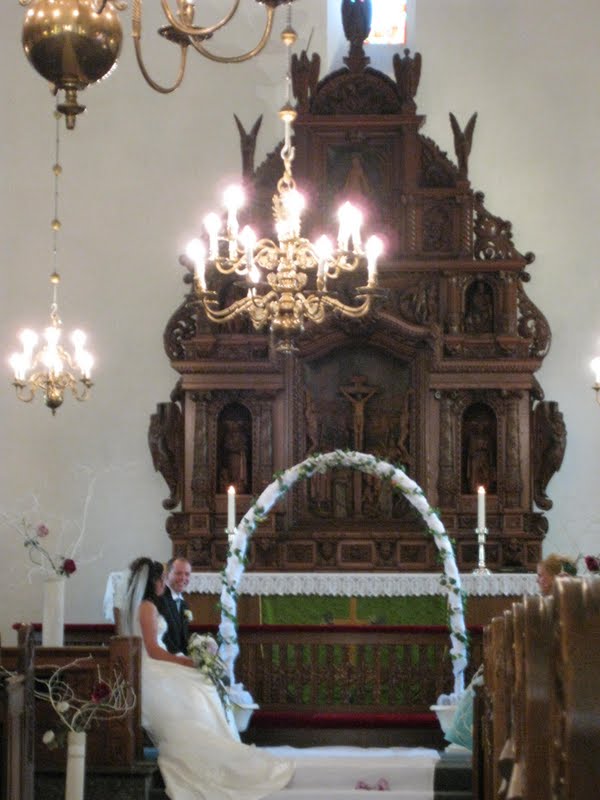
In Norway, there are four types of invitations that go out for weddings.  The first is a newspaper announcement which serves as an invitation for any and all who want to attend, to come on by the church and watch the bride and groom become man and wife.  No need to RSVP.  If the church gets full, the pews get cozier.  And there is no obligation to bring a gift, as there’s a good chance no one even knew you were there.

Norwegian weddings look like American ones with a few exceptions. There are chairs at the front of the church with the bride and maid of honor on one side facing the groom and best man on the other.  There are no other attendants.  Songs are sung, candles lit, the priest talks and prays.  When the time comes to exchange vows, the couple briefly stands up.  The maid of honor moves over and for the remainder of the ceremony, the wedding couple sit side-by-side.  It’s difficult to see what’s going on with everyone sitting, but Norwegians appreciate the ability to relax, even on their special day.

Prior to the wedding, immediate family and close friends get an invitation to attend the formal dinner after the ceremony.  And I mean formal.  There are place names, seating charts, a master of ceremonies, speeches and a schedule.  Everyone in attendance is expected to give a speech, read a poem they have written, or sing a song.  It’s common to take a familiar tune and rewrite the words telling something cute or embarrassing about the couple.

These speeches take several hours and are intermixed with food being served.  There is no side chit-chat, as all attention must be on whoever has the floor.  Most wedding dinners only have about thirty people in attendance because this part of their day is the most expensive.

The third invitation is sent out for coffee and cakes after dinner.  Extended family members and other friends are invited for this less formal gathering.  The speeches continue into the night, with breaks occasionally to look at the gift table or use the bathroom.  (There are people that open the gifts the minute they arrive and put them on display.)

It’s not uncommon for wedding celebrations to last until the next morning.  No one leaves early and there’s plenty of coffee to keep everyone awake.

The last invitation comes the next day for the “reste selskap” (the rest party) where others gather to eat the “rest” of the leftover cakes.

So if you ever have the honor of being invited to a Norwegian wedding, know you will be giving them more than a material gift.  You will be giving them the gift of your time – and lots of it.