Sunday, December 22, 2013

The Rest Party


Relaxing is a huge priority in Norwegian’s lives.  It seems to me they live just to relax.  They have a couple different terms they use to describe this special time in their lives – one is “slapp av” which translated means “relax” and another is “kose deg” which means “enjoy yourself” - in a cuddly kind of way.

Each day, it’s important that Norwegians both relax and enjoy themselves.  Those two things actually go hand-in-hand.  I’m honestly surprised they get anything done, as there is so much emphasis put on just taking life easy.  In the work place, the law states that all employees have a right to be “stress free.”  If an employee feels stressed, it’s justification for taking an extended sick leave where they get paid to have time to just “slapp av.”  I read a newspaper article a few years ago that said on any given day, over twenty five percent of employed Norwegians are not at work. 

Even in their schools, the emphasis is not on academics – they care more that the children enjoy themselves while they are there, than actually learn anything meaningful.

If the sun is shining, Norwegians enjoy themselves out on the deck.  A cup of coffee in hand is also an important part of the “kose deg” experience. 

My husband’s cousin met up with us in Florida once because he wanted to go to Disneyworld.  Our schedules were such that we only had two hours together that day, but he still insisted we go.  Once we got through the entrance gates, all he wanted to do was sit down and have a cup of coffee.  That was how he planned to enjoy Disneyworld.  I thought he was nuts, but from what I can tell, many Norwegians are cut from the same mold.  Nothing could be better than just sitting down and enjoying the moment, with a cup of coffee in hand, no matter where they are in the world or how much it cost them to get there.

So when we were living in Norway, I got a text message from my friend Kristin, inviting me to a “reste selskap” – which I thought translated as a “rest party.”  I’d never heard of such a thing before and had no idea what it meant.  The first thing I thought was that Kristin was going to have a bunch of people over to just relax together.  It made sense.  Then I thought maybe it was something like a Tupperware Party, where we buy things to help us “rest.”  Both ideas seemed possible based on my experience with Norwegians.  Either way, I thought I should go.

I was pleasantly surprised when I showed up at Kristin’s house to see her table covered with fourteen partially eaten cakes.  As I soon found out, Kristin’s daughter was Confirmed the day before, so I and several other friends, were invited over to eat the “rest” of the food from that party, which I enjoyed very much.

Clicks


I had several major “clicks” pertaining to my husband, the year we lived in Norway.  I was not previously aware that many of my irritations with him were just his cultural norm.  Now I know.  

The first click came the day I learned about pronouns in my Norwegian class.  There are different pronouns to say “hers” or “his” of course, but Norwegians use extra pronouns for those same words, depending on whether the “hers” or “his” is the object or subject in a sentence.   

To say “her” as the object, it’s “hennes,” but as the subject, it’s “si.”  Often, when Kory is retelling a story, and there are more than two people of the same gender involved, he completely loses me and I have no idea who did what.  Now I know why - the English language is limited in their use of pronouns.  The Norwegian language makes it much easier to track who the “he” or “she” is in the conversation and since that is my husband’s native tongue, his brain thinks of those language rules first.  When Kory talks in English, he converts everything to just “he” or “she” and while it’s perfectly clear in his mind, I’m always having to ask him, “Who are you talking about?” because he never clarifies by using their names. It’s just so darn irritating.

Another “click” came in the arena of Kory’s palate. When we were first married, I made him some yummy lemon chicken and when I asked how he liked it, all he could say was, “I like my chicken to taste like chicken.”  Apparently the effort I put into marinating the chicken in lemon juice for 24 hours was not appreciated.  After having been around Norwegian food for a year, I now realize they boil or steam nearly everything and put spice on practically nothing. 

But the biggest “click” about Kory came the day The Good Teacher Inga told us that Norwegians don’t really tell anyone they love them.  Maybe once, before getting married, they might utter the word “elske” (love), but for the most part, it’s a very rarely used word.  Even parents talking to their children don’t say it.   

They have a saying, “Jeg er glad i deg,” which literally translates as “I am happy with you.”  That’s it.  That’s all you get.  That’s their toned-down version of “I love you.”  That’s what spouses say to one another and that’s what parents tell their children.  There is no love being spread around in Norway, that’s for sure, unless they are talking about Norwegian chocolate, then someone might be brave enough to utter the “elske” word. 

Years ago when I complained about his lack of verbal affection toward me, Kory just gave me the old line, “I told you I loved you when we got married.  If I change my mind, I’ll let you know.”  It’s been 22 years.  If he ever does tell me he loves me again, I sure hope he doesn’t use any pronouns.  

Flags


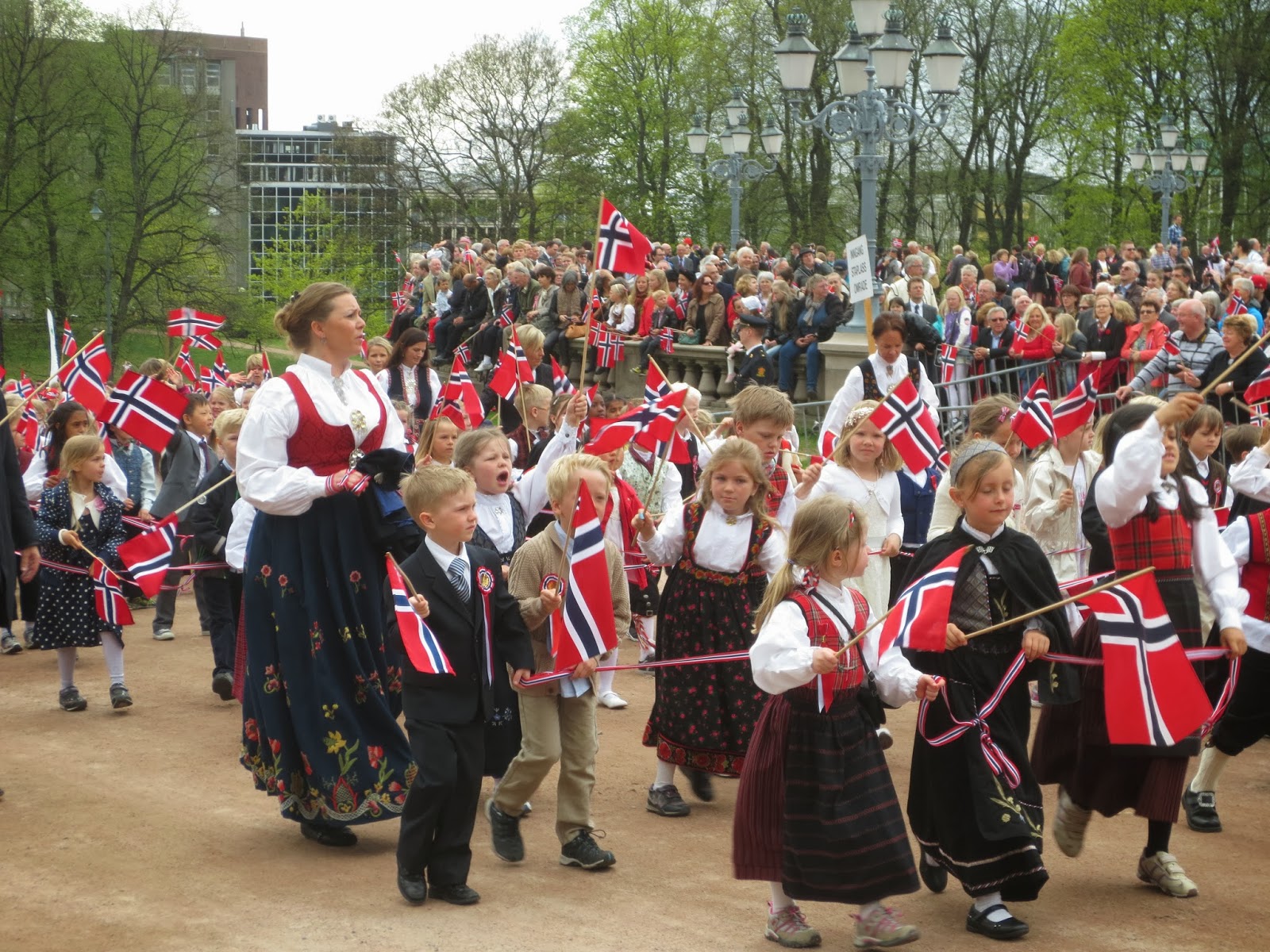
I think Norwegians love their flag, even more than they love their own mothers.  I’ve never experienced anything like it.  They beam with pride when they gaze upon it, as if watching their child take its first step.  It might have something to do with that first step Norway took away from their tie with Sweden back in 1814, or that the Germans wouldn’t allow it’s presence to be seen at all during WWII.

Unlike the flag in America, that can fly anytime, the display of the Norwegian flag is highly regulated.  I’ve noticed, just by being a parent, when something is restricted, it creates a greater desire for that thing – so that might have something to do with their passion for it.

Every flag purchased has a card attached with all the rules surrounding its use.  America has certain rules around the use of its flag, too, but I’m guessing only the Boy Scouts know them by heart, but in Norway, everyone knows them.  

To begin with, the flag is only allowed to fly on national holidays like New Year’s Day, Easter, 17th of May, Labor Day, Pentecost and Christmas.  It’s also allowed on the birthdays of royal family members.  When the flag is flying outside individual homes on days other than these, it signifies some big celebration is going on, whether it’s a birthday, wedding, baptism or confirmation.  I’ve even seen the flag flying to signify visitors have come from America.  The flag is also allowed to fly at half-mast if someone has died.  The State Church flies their flag at half-mast also, but only during the time of the funeral.

The time of day the flag is allowed to fly is also very regulated.  During the winter months, November through February, it can’t be hung out until nine in the morning and must be back in by nine at night.  The rest of the year it can come out at eight o’clock. The rules slightly change for those folks that live way up north – they are only allowed to fly their flag from ten in the morning until three in the afternoon because they have so much less daylight.  I’m sure some have moved further south just so they can fly their flag longer.

As predictable as the church bells are on a Sunday morning, on days the flag is allowed to fly, at the exact moment the hands of the clock strike the hour, front doors open, and flags appear.  Everyone is standing just inside their door like a runner at the starting gate, waiting to be the first one on their street to fly it.  Likewise, I’ve been to parties where people leave early in order to bring in their flag by “quitting time,” or they arrange with a neighbor to take it down.

Inside every home is a tabletop version of the flag, displayed year round, 24 hours a day.  Thankfully, there are no regulations around that one so the Norwegians have reason to smile each and every day.

Monday, October 21, 2013

Discipline


Disciplining my child has to be my least favorite part of being a parent. There are people who think I don’t discipline enough, and others who think I’m far too strict.  Most of the latter would be our friends and relatives in Norway, since the gold standard for discipline there is just a good talking to.

One day, my son was playing games far too long on his laptop.  I told him to put it down and find something else to do with his friend who was here visiting from Norway.  He closed it right away because he knew if he didn’t, he’d lose the chance to use it the rest of the day and/or the following day for being disobedient.  The Norwegian mother also told her son that he needed to put down his computer so he could take a break as well.  He responded with an emphatic, “No.” 

In my house, that’s a word with big consequences, but in Norway, it’s thought best to let children express themselves.  She told him again to turn off the computer and again he said, “No.”  After the third time, she just rolled her eyes and said nothing more while the boy played on.  I told her I would have taken away all electronics for a week if Kaleb would’ve disobeyed me like that.  “Oh, I could never do that,” she said, “it would never work,” meaning, her son wouldn’t obey that command, either.

Our part of Norway is known throughout the land as being extraordinarily lenient when it comes to disciplining the children.  The parents I’ve talked to about this just assume the children will figure out for themselves, what behavior works and what doesn’t.  Most parents set no boundaries and even if they did, the only consequence to any disobedience is just a lecture.  

Norwegian parents take on the role more of a friend than an authority figure with their children.  Some say it comes from the guilt they feel that both parents now have to work outside the home in order to maintain the high standard of living they all want, so they go overboard with indulging their kids.

I heard parents talking once about another child and the relationship he had with his parents. They said what sounded like, “they sewed pillows under his arms,” so of course, I had to ask what that meant.

Turns out, they have an expression in Norway that translates literally as that, but it means the child is spoiled.  The picture being painted is of a child with it’s arms outstretched because there’s been pillows sewed under them, attached to their body so the arms can’t even bend and they just walk around helpless, waiting for others to do things for them. 

I guess none of this should be too surprising since I’ve seen far too many Norwegians adults who still have those “pillows sewn under their arms,” as their socialistic government does a great job of taking care of all their needs.

Names


Long before our son was born, my husband and I were in constant disagreement over what his name should be.  I wanted a Biblical name - he wanted a traditional one. 

In Norway, it’s customary to name the first born after the paternal grandfather.  The second born son gets the name of the maternal grandfather and the girls likewise get named after their grandmothers.  I figured our son was already going to be saddled with a Norwegian last name, and since we were living in America, why name the kid something like Halvor?

My father-in-law was born Halvor Gunderson Strand.  His name followed tradition as he was named after his mother’s father because he was the second born son.  His “middle name,” which Norwegians actually refer to as their last name, is the name of his father, since he is indeed, Gunder’s son. 

What we American’s think of as his last name, is actually his address.  So he was known as Halvor, Gunder’s son who lives at the beach, because that’s what “strand” means in Norwegian.  The farm names in Norway always depict some geographic location where they are situated so it’s possible to tell one Halvor Gunderson from another, as there’s a good chance there are many in the area with the exact same name.

When Halvor’s family moved from the farm near the beach to a farm on a “harvested hill,” their “last name” changed from Strand to Slaatthaug.  This was how it was done in Norway for centuries – people’s names changed when they moved to a different farm because their name identified exactly who they were.

In 1923 however, the Norwegian government realized it was too difficult to keep track of people, based on this naming convention/tradition, so they made a law that said everyone had to keep whatever their name was at that time, and even if they moved, they shouldn’t change it, so that tradition died out.

First names are still recycled over and over again in Norway but the middle name tradition has also died out.  It’s most common now in Norway to take the mother’s maiden name as the child’s middle name.

Another tradition that’s also died out is naming the newest family member after the last one that died.  I’ve seen birth records for families that had four children, all with the same first name because the first three died.

Up until twenty years ago, all baby names had to be submitted to the Norwegian government for approval before a birth certificate was issued.  It was thought that having an unusual first name might be detrimental to the child, so conformity and standardization was encouraged.  But with traditional first names like Dagfinn, Roar, Oddrun, Bent, Birger, Frode, and SnΓΈrre, ya gotta wonder what they were thinking.