Wednesday, May 12, 2010

Ambiance

My husband, Kory, retired two weeks before our son was born, so for over ten years we had no schedule, no alarm clock, no rushing out of the house in the morning. Most every day we’d sit at our dining room table, look out over the Skagit Valley while leisurely drinking a cup of coffee and talk about what the day would bring. Sometimes when Kaleb and I homeschooled, we’d stay in our pajamas all day. Our lives in Norway were everything BUT that. Everything had to be planned out ahead of time. I had to double check to see if we had clean clothes for the next day and enough food to make lunches. I had to put a clock in every room because I had to catch a bus and Kaleb had to get to school on time. Kory even had to go back to work to off-set the high cost of living there, so two days a week he was a carpenter again. We were on a schedule with very little time to relax.


One day soon after starting work, Kory discovered they don’t have sani-cans on the job sites in Norway – so he had to drive all the way home to use the toilet. He said his co-workers just head for the nearest bushes, which is OK under certain circumstances, but it wasn’t going to work too well for him that particular day.


About the same time Kory was rushing home to use the bathroom, my Norwegian class was heading off to a concert by Ålesund’s finest string quartet. Norwegians are very much into “culture” and ambiance. Each morning my school day was started off with a little soft music to settle everyone down. There were always blooming flowers in our classroom and little doilies with candles on the tables in our break room.


In America we often associate candles, flowers and music with relaxation and romance, but in Norway, it’s an everyday thing, even in the workplace. At least in office jobs, anyway. My bus passed by several office buildings and I always saw employees sitting in their break room – complete with flowers, table clothes, candles burning, and I imagine, music softly playing in the background.


At his job, I don’t know that Kory would have cared so much about the ambiance of candles, flowers or music, as much as he would have just liked a toilet to sit on every now and then.

Friday, May 7, 2010

Bullies

My son, Kaleb, made friends right away with Victoria, a girl in his class from America. She was the only one who could speak English on the playground so the two were inseparable. Within a few weeks of school starting, Kaleb informed me there was a kid in another class that must really be in love with Victoria. He was sure the kid was jealous of him and his friendship with her because he looked for every opportunity to beat Kaleb up. Apparently the kid (already sporting a red cast on his swinging arm) hadn’t landed one on Kaleb because of how clever Kaleb had been in escaping the attempted blows using his “Avatar” moves. He said it wasn’t so easy one time when the kid brought his friend (who had a black eye) along and they cornered him in the changing room. Victoria came to his rescue and he managed to escape without injury.


Kaleb told his teacher about these bullies a few times, but apparently the boys are well known as the school trouble makers (hence the black eye and broken arm) and all the teacher did was talk to them. Kaleb wasn’t the least bit upset in retelling the tale - he kind of had a glimmer in his eye and a smirk on his lips as he felt the whole thing was rather entertaining, but that’s of course, because no one had yet landed a punch. He lost the glimmer and smirk the day he actually got nailed. Ironically, it was on the day he brought home an “anti-bullying” contract from the principal that was sent home for all children and parents to sign. The contract clearly stated the school has ZERO tolerance for any kind of “mobbing” (bullying) or violence, but it failed to say what the consequences of such behavior would be. As it turned out, the worst possible punishment in Norwegian schools for violence is a stern “talking to,” so “mobbing” became a huge part of Kaleb’s life at school. One kid in Kaleb’s class, Morton, had an “impulse control problem,” and unfortunately, his impulses often landed on my sweet boy’s face. I’m sure having Morton and his pals sign a piece of paper is exactly what was needed to change their behavior.

(The photo is of Kaleb and his best friend, Toban.)

Wednesday, April 28, 2010

My Norsk Classmates

One day during break in my Norwegian class, Mai, a classmate from Thailand, offered to share her snack. She handed out apple slices dipped into a mixture of sugar, salt and a dry Thai spice mix. I tried it. It was better than a cup of coffee to wake me up. She said people in Thailand always like to have a little “hot” with something sweet. She wasn’t kidding. No one else but me asked for a second slice. I only had five hours sleep the night before so I needed the extra “wake-up.” I’m sure I gained some respect that day as everyone looked at me in awe when I took the second bite.


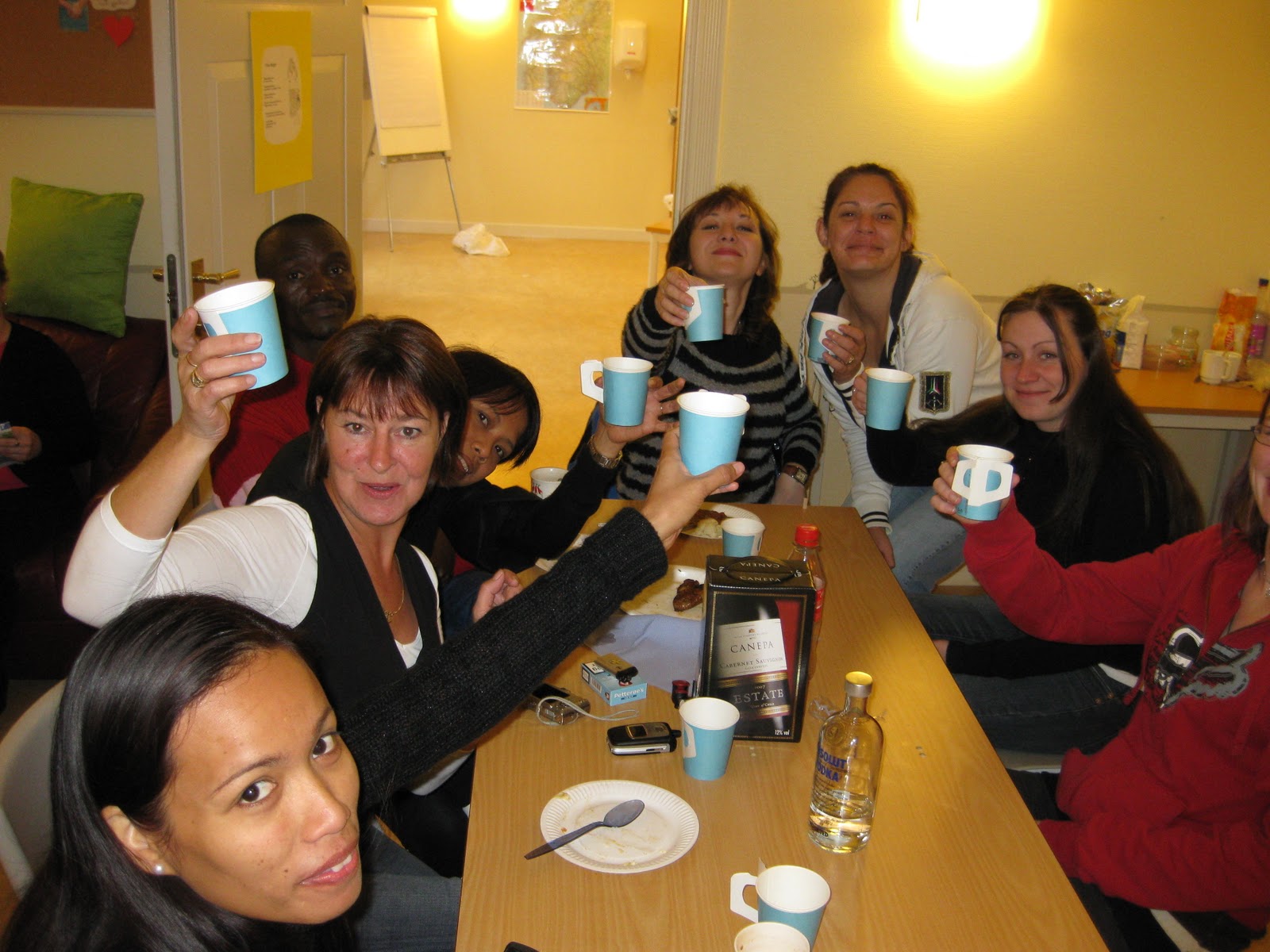
We had 28 students at the beginning of my Norsk class, from 18 different countries. Most of them are women married to Norwegians. We were put together because supposedly English was a language we all knew, and it made learning Norwegian easier if explanations could be made in English at times. If nothing else, it made for some interesting coffee breaks as we tried to communicate with one another. I found many of my classmates’ stories quite interesting.


The woman that sat behind me was from Germany. She is a pediatric doctor, her husband, a dentist. The government solicited them to work in Norway because there aren’t enough medical professionals in the country. (German dentists are the norm in Norway.)


The woman that sat next to me was my partner when we practiced our pronunciation. Her name is Vestina and she is from Lithuania. She was 22 and she moved to Norway with her boyfriend to work also, but on the opposite end of the spectrum from the doctors and dentists. Many service jobs and fish factories hire people from Eastern Europe to do the grunt work that no respectable Norwegian citizen wants to do. Vestina and her boyfriend worked in a fish factory. Not a single Norwegian was on the payroll there, including their boss, who was from Canada.


Another woman in our class was from the Ukraine. She met a Norwegian via the internet and married him. She knew NO Norwegian and very LITTLE English. I saw them together during lunch one day and even though they’d been married a year, they still acted like love birds. He was a balding, forty-ish, not so hot looking guy and she was in her early twenties and quite the hottie. Norwegians aren’t dumb, that’s for sure.

Thursday, April 22, 2010

Word Genders

I nearly developed an aneurism the day we learned about the gender of words in my Norwegian class. The gender matters greatly because it determines which “a” or “the” is used. For a masculine word, the Norsk article “en” is used, so “a car” would be “en bil” or “the car” is “bilen.” The same article is just attached to the end of the word instead of putting it before the noun to distinguish between just any car or one specific car.


If the word is neutral, the Norsk article “et” is used, so “a table” is “et bord” or “the table” is “bordet.” And if the gender of a word is feminine, well, that’s a whole other story. Is it a coincidence that the feminine version of a word has all the exceptions to this otherwise easy rule?


After tremendous effort identifying masculine/feminine/neutral nouns, The Good Teacher Inga then told us that the entire city of Bergen has decided to give up the feminine gender of nouns and they just use either neutral or masculine articles. But, she said, since we lived in Ålesund, we had to follow the proper rules of grammar and know all three versions. (I feared we might lose half the class to Bergen after that bit of news, as the toughest part of this section of grammar were the exceptions that go along with the feminine gender of words.) The worst part is there is no way on earth to know what gender words are – she basically suggested we memorize the entire dictionary so we will know for sure. I wanted to cry.


Inga also spent a great deal of time explaining the many different ways one can say “it,” depending on the gender of the word. I’m sure Bill Clinton must be part Norwegian, as after that lesson, it would be easy to understand his confusion over the meaning of the word “it.” “It” can be written “den” or “det,” but those same words are also used for “this” or “that.”


It would have been so nice if all I had to know was how to say “Hello” and “Good-bye” because all the other information about how to carry on a decent conversation nearly became the death of me. Maybe that’s why Norwegians, as a whole, are so tight lipped? It might just be easier for them to keep quiet about things than to try and remember all the rules of grammar and risk sounding like an idiot when they carry on a conversation.

Wednesday, April 14, 2010

Homeschooling Not Allowed


Before we enrolled our son, Kaleb, in public school in Norway we were required to have a meeting with the rector and the school administrator. They are two very serious men and they seemed quite concerned that we decided to put Kaleb in their particular school. They talked rather sternly about how important it was for Kaleb to obey the rules and not be a disturbance and they questioned our reasons for homeschooling him all these years in America (it’s only allowed under special circumstances in Norway). In Norway, socializing is their number one goal. Academics are an afterthought. Everyone is treated equally and above all else, everyone learns tolerance for one another.


The school where Kaleb attended is a sort of experimental school in that it has no individual classrooms – it’s all open with areas for the students to move around throughout the day as they progress from one subject to the next. One student acting up can disturb 90 kids all at once so they made sure we knew they have zero tolerance for goofballs. It was boot camp for social behavior, which was one of the main reasons why we moved there. We put Kaleb in fourth grade even though his age would have placed him in fifth, but with not knowing the language, we decided it was best to put him back a year. It was a good move.


Kaleb met one of his main teachers a few days before school started. She explained the school schedule and how the days are structured. When the bell rings, the children come in from outside and take off their outside clothes (jackets and boots, etc.), put on their inside shoes, and line up in the changing room to wait for her to escort them to their areas. Instrumental music plays in the background as she greets each student every morning with a handshake and the student must give her a greeting in return. When they break out into groups to work on different subjects they are assigned a partner to work with so that by the end of the school year all the kids have worked one-on-one for several weeks with all the other kids in their class.


Kaleb told her he hoped kids would want to be his friend because he was “special” since he was from America. She nipped that thinking in the bud right away when she responded with, “In Norway, we are ALL special.” Okay, then.

Wednesday, April 7, 2010

Norsk Food

Every August, our hometown of Ålesund held a matfestival (food festival) right down along the harbor.


The best part of it is watching the chefs compete in making cool looking uncooked food. Inside the tents are all kinds of food displays and samplings to be had. If a person actually liked Norwegian food, they would hit the jackpot by going there – but I’m not particularly fond of all the sausages, cold smoked and jelly-ish salmon, or whale meat.


While walking through the festival tents the year we lived there, I did manage to get a free cup of coffee and a few chocolates. But then I needed to leave quickly to escape the aroma of all the dried fish and sausages.


I swear, you could put anything in a brown colored tube and put the word for sausage, “pølse,” on it, and Norwegians would eat it. They have big ol’ coils of sausages in the grocery stores. You just grab and yank off however much you want and pay for it by the kilo. They are as crazy about their pølses as they are about their cakes and vanilla sauce.


I was offered more than one sample of some scary-looking sausage at the festival and not wanting to offend the vendors I just responded in Norwegian with, “I don’t eat meat.”


If it were up to me, I’d just eat Norwegian breads, cakes, vanilla sauce and cheeses, but my husband and son would revolt – they both love all kinds of creatures sliced and diced and stuffed into little packages.


At the festival there was a whaling ship pulled up to the dock selling the fresh whale meat right off the boat. A guy nearby was selling stir-fried whale meat to go.


Norway is so proud of the fact that they still kill those majestic creatures, that one of their politicians designed a T-shirt with a drawing of a whale on it that says, “Intelligent people need intelligent food.”


My husband, Kory, bought ten of those shirts a few years ago and gave them to a friend from the Makah Indian tribe.


Even though whale meat is one of my husband’s favorite foods and he eats it often in Norway, I haven’t noticed it has made him any smarter, however.

Thursday, April 1, 2010

Learning Norwegian

I began going to Norwegian language lessons just weeks after arriving in Norway.


I was lucky to get The Good Teacher Inga as my Norsk teacher, because she was indeed, very good.

After she passed back one of our first writing assignments, I noticed she wrote “Bra” (translation: “Good”) on several papers, but on mine, she wrote, “SUPER!” (meaning “Excellent”). “Super bra” would have been just too funny, I guess.

She also drew a big smiley face below my first Norwegian paragraph. You never get too old for a smiley face. It did make me proud.

The Good Teacher Inga also complimented me early on for my pronunciation. She said I was “flink” (“capable”).

I loved that class. I struggled to remember the letter J sounds like a Y and the letter I sounds like an E and the letter G sounds like a J, plus all the rules of grammar, but I managed to find something to laugh about every day.

For instance, if you say “chew-a-shoe,” you have just said the number “27” in Norwegian.

Another funny thing is what sounds like “Snoop doggy dog” (Isn’t that a rap star or something?) means “candy day today.” Traditionally, many kids get candy only on Saturdays – so it’s a common saying on Saturday mornings.

We had to learn proper “bokmål” Norwegian, but most people still speak the other older, official version of Norwegian ironically called “nynorsk” (new Norwegian).

They aren’t the same. We also had to learn the special dialect from our area so when we went out on the street, we could understand what in the world people were saying (fat chance). There are over 400 dialects in Norway so it’s not uncommon for Norwegians to not even understand each other.

One of our first lessons was on the secret in pronouncing the vowels: if there is a single consonant after the vowel, the vowel sound must be stretched out, but if there is a double consonant following the vowel, then the vowel sound must be quick.

This is very important, when say for instance, you are asked what you want for your 18th birthday and you say “bil” (pronounced “beeel”) which means “car.” If you didn’t stretch out that “e” sound, and you said “bill” you would end up with a beetle – and not the Volkswagen kind either.